

Blog
The Cognitive Conundrum in the modern times
Arka Global
September 21, 2025
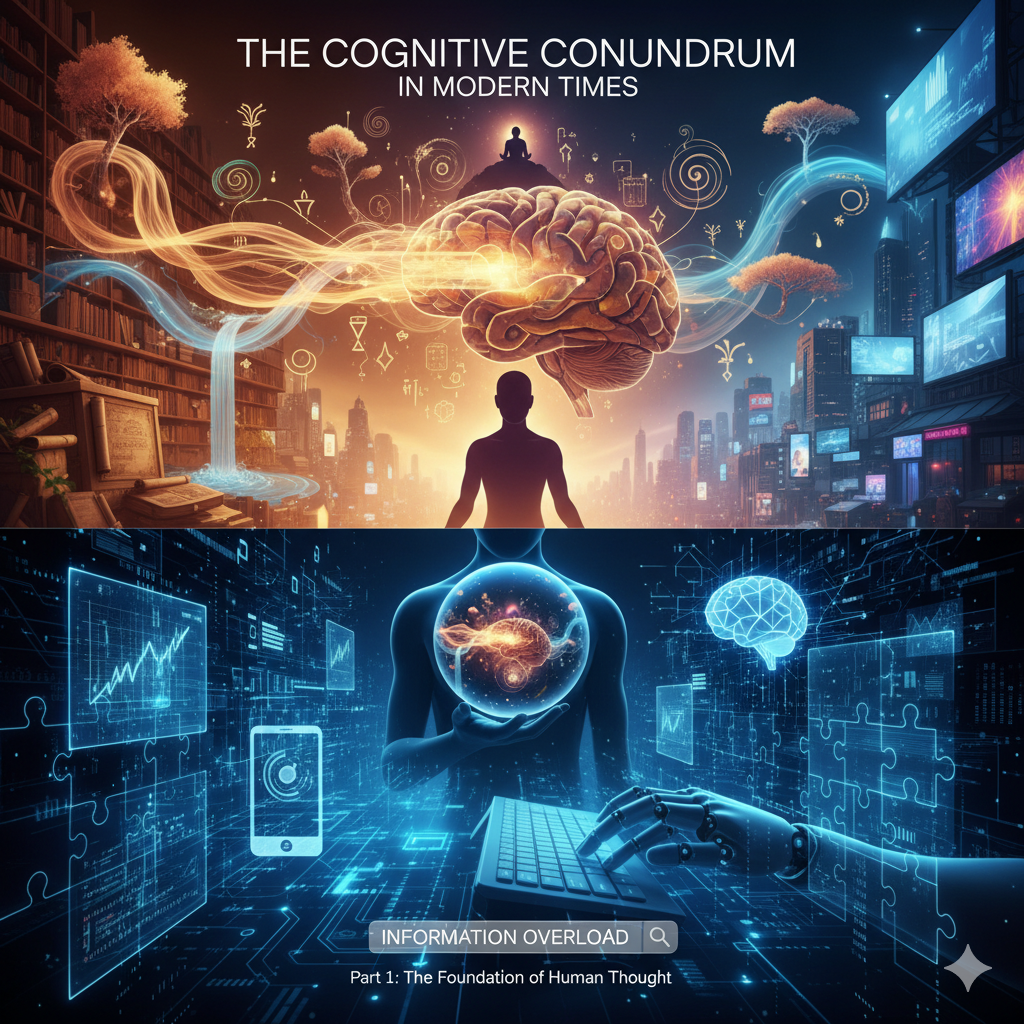
The Cognitive Conundrum in the modern times.
The origin of thoughts has been a subject of inquiry for some time, both philosophically and scientifically (ancient and modern science). It is a complex interplay of factors: external stimuli, stored mental imagery, and cognitive processes such as reasoning and imagination.This series of articles aims to help readers better understand and manage their cognitive processes in this era of information abundance and rapid technological change. In part 1, I explore the complex interplay between the thoughts that empower us and the new paradigms introduced by the digital revolution. This includes the rise of structured thinking through modern education systems, the impact of computer science in augmenting human cognition, and the emergence of AI as a new cognitive frontier.
I examine how the digital age has reshaped our information landscape, leading to challenges such as information overload, diminishing attention spans, and new demands on information processing and retention. I also discuss the changing perception of intelligence in this information-rich era, including the influence of English language dominance in global discourse.
Throughout the article, I highlight examples of cognitive challenges in the digital age, such as the debate around smartphone use in educational settings. I also provide a comprehensive list of solutions practised in different cultures to manage cognitive processes worldwide through centuries, offering readers a broad perspective on approaches to cognitive management.
The foundation of human thought
Our journey of understanding begins at birth. We use our five senses to understand the world around us. While interacting with the senses and surroundings, our thoughts are activated in some areas of our brain. These thoughts, combined with our experiences, become part of our beliefs, values, and principles. These values, beliefs, and principles form the basis of our cognitive framework. The framework then influences how we perceive and interpret new information.
Human thinking can be conceptualised in many ways, with one perspective being spontaneous and structured thinking. Humans apply spontaneous or structured thinking, or both, depending on the context and need in which we use them. Spontaneous thinking has been an evolutionary friend, but structured or “rational” thinking has gained prominence in recent centuries, mainly through modern education systems and scientific advancements. In the last few centuries, through modern education, which leads to a lucrative career, societies worldwide have emphasised structured or “rational” thinking. This trend is particularly noticeable in many industrialised societies, where structured thinking is often associated with specific career paths.
While these skills are undoubtedly valuable in the context and situation, an overemphasis on structured thinking, particularly under time constraints and data overload, can potentially lead to significant stress for individuals, highlighting the need for balance and self-care. It is essential to point out that spontaneous and structured thinking have their place and can be complementary rather than mutually exclusive.
As our understanding of this field evolves, humans need to understand the strengths of these cognitive frameworks and be adaptable to using them depending on the context and situations. This could be one of the possibilities to reduce stress that has plagued modern lives.
Computer Science: Augmenting Human Cognition
The emergence of computer science was driven by exploring new paradigms of information processing and doing complex tasks beyond the biological remit of humans. With advancements in this field, humans have discovered ways to be more productive within linear time constraints. Grounded in contemporary scientific concepts of finding solutions to human problems, this field aims to enhance human capabilities. This field drew inspiration from theprinciples of structured thinking—decision-making, logical reasoning, memory, and problem-solving– to develop algorithms and computational models. Sophisticated programming languages were designed to bridge the communication gap between humans and machines.This advancement was made possible by concurrent progress in computer hardware and interaction with physical devices without direct equivalents of biological constraints. As humans tried to understand the world around them using their five senses, the hardware was used to emulate the same.
The Internet Age: Information Abundance
Building upon these foundational developments in computer science, the advent of the Internet marked another revolutionary leap. This global network leveraged the power of computational advancements to reshape human connectivity and information access dramatically. It provided an interconnected, globalised view of the world. The Internet democratised education and information, making vast resources available online and breaking down traditional barriers to learning. However, this unprecedented access to information has also presented new challenges. The explosive growth of social media platforms, enabled by advanced algorithms and high-speed data processing, has led to an era of information abundance. While this offers immense opportunities, it has also accelerated the phenomenon of information overload, presenting individuals with the complex task of navigating, filtering, and critically evaluating an ever-expanding data overload.
The Social Media Age: Information Overload
Social media platforms have significantly influenced lifestyle perceptions and choices. As social media consumption becomes more accessible with the latest smartphones, information is available with a screen flick. While they offer opportunities for connection and learning, they can also contribute to unrealistic lifestyle expectations and frequent dopamine-driven reward cycles.
The New Paradigm of Intelligence
In the face of unprecedented information accessibility, a new paradigm of perceived intelligence emerged. Individuals found themselves in a race to consume and process vast amounts of knowledge, often equating the ability to absorb and articulate information with intelligence rapidly. This shift in perception coincided with the global dominance of the English language in the societal discourse. While intelligence has always been valued across human societies, its definition in the information age has become increasingly tied to one’s capacity to navigate and leverage the flood of available data. In this context, proficiency in English—the de facto language of the internet often became blended with intellectual capability.
Challenges in the Age of the Internet and Social Media
This digital revolution has also introduced challenges related to information processing. As our thoughts are out of control, we constantly look for interactions with our surroundings and create experiences within time constraints. With our attention span and focus diminishing, we have problems where structured or spontaneous thinking is not done correctly. We tend to rectify these problems using prescriptive protocols for changing habits and behaviour.
The human brain, which continues to adapt and evolve slowly, has limitations in its capacity to process and retain large volumes of information simultaneously. Recollection happens from stored mental imagery. Modern cognitive research shows that information retention and recall can vary widely among individuals and depend on factors such as the type of information, personal relevance, and mode of presentation.
It is important to note that modern studies have yet to conclusively conclude the impacts of social media. Recently, I read that prestigious educational institutions like Eton College in the UK are considering banning smartphones in schools and junior colleges. In addition, I have also read about the founders of tech companies and former presidents of the United States who have not allowed their kids to have access to digital gadgets until they are 14.
Looking Ahead: AI
As AI seeks to augment humans’ structured thinking by giving weightage to words and working iteratively to respond, it introduces a new dimension to our cognitive landscape. Artificial Intelligence, particularly machine learning and natural language processing models, can now process vast amounts of information and generate human-like responses. This development presents both opportunities and challenges in the context of human cognition.
Prescriptive Solutions to Address these challenges
Throughout history, diverse societies have developed a rich tapestry of concepts and practices to address the complexities of human thinking. These approaches have evolved in response to their respective eras’ unique challenges and structures. A vast body of literature has emerged from various sources, including philosophical treatises, religious texts, and, more recently, scientific inquiries.
This wealth of knowledge encompasses various topics and techniques, each offering distinct perspectives.
• Philosophical and psychological concepts: consciousness, awareness, the unconscious mind, spontaneity, and rational thinking.
• Modern Scientific approaches: neuroscience and cognitive psychology aim to understand thought processes’ biological and functional aspects.
• Traditional practices: Vedic and Western Astrology predict the impact of the planets’ positions on human beings, thereby altering the thought process; Tantric Methods to hypnotise, Vaastu (an Indian architectural system), and Feng Shui (Chinese geomancy) propose harmonising living spaces to influence mental states.
• Religious and devotional practices: Contemporary devotional and bhakti (devotional) movements explore the relationship between emotion, thought, and spiritual experience.
• Mindfulness and Meditation: Various techniques from different traditions (e.g., Vipassana, Zen and others, TI Transcendental Meditation) aim to cultivate awareness and alter thought patterns.
• Alternative healing therapies: Crystal and gemstone therapies propose connections between physical objects and mental states.
• Psychological concepts: such as “flow” by Mihaly Csikszentmihalyi, ” Thinking Fast, Thinking Slow” by Daniel Kahneman, “The Secret” by Rhonda Byrne, “Pyscho-Cybernetics” by Maxwell Maltz, Vision Statement and Boards prioritisation using various methods, pomodoro and time-blocking protocols, 4×4 decision matrix and structured problem solving (5W, mind mapping) which are protocols to alter the thought process.
• Cognitive Behavioural Therapy (CBT): Psychotherapeutic approach modifies dysfunctional thoughts, behaviours, and emotional responses.
• Neuro-linguistic programming (NLP) proposes a connection between neurological processes, language, and behavioural patterns learned through experience.
• Positive Psychology: The scientific study of human flourishing, focusing on strengths, virtues, and factors contributing to a meaningful life.
• Stoicism: An ancient Greek philosophical approach that emphasises logic, ethics, and the development of self-control to overcome destructive emotions.
This diverse array of approaches reflects humanity’s ongoing quest to alter the thoughts. Each offers unique insights, ranging from ancient wisdom to modern scientific research, collectively contributing to our evolving understanding of the human mind and its potential.
Conclusion: Navigating the Cognitive Landscape of Tomorrow
As we stand at the intersection of traditional cognitive processes and cutting-edge technological advancements, we face a pivotal moment in human intellectual evolution. The landscape before us is shaped by the interplay of structured thinking, the challenges of information overload, the pervasive influence of social media, and the rapid emergence of artificial intelligence.
In the following few articles, I will elaborate on some of the prescriptive solutions I am familiar with. I will also discuss the role of human-centric structured thinking and its relevance in the age of AI.
About the Author

Pratik Kothari
Pratik’s career spans over 25 years of international experience, taking him across continents and immersing him in diverse localcultures. Pratik completed his Computer Science education at Nagpur University, India and his MBA from the UK. Through the lens of his education, Pratik has contributed in executive roles while working in consulting firms, global organisations, and startups, providing him with a rich, multifaceted perspective on business and culture.
Pratik has collaborated with CEOs and founders and worked in more than 40 countries throughout his career, helping them drive growth and scale their business operations.
Beyond his professional life, Pratik is an avid adventurer and a podcaster. Pratik has scaled various UK and European peaks and has been to Everest Base Camp. These pursuits have deepened his understanding of human adaptability, awareness, and resilience – themes that are prominently featured in his writing.
His writings aim to create narratives that inform and inspire readers to think critically and push boundaries in their lives and careers.